
Generative AI has moved rapidly from experimentation to boardroom
priority. Business leaders are no longer asking only, “What can
generative AI do?” They are asking more practical questions: Where
should we start? Which use case will deliver measurable value? How
should company data be protected? What will implementation cost? And how
do we move from an impressive demonstration to a dependable production
system?
Those questions matter because a successful generative AI initiative
involves much more than selecting a large language model and building a
chatbot. It requires a clearly defined business problem, reliable data,
appropriate architecture, security controls, human oversight, system
integration, user adoption and continuous measurement.
Without that foundation, organisations often create proofs of concept
that look promising in a controlled demonstration but struggle with
inaccurate responses, unpredictable costs, weak adoption or security
concerns when exposed to real users.
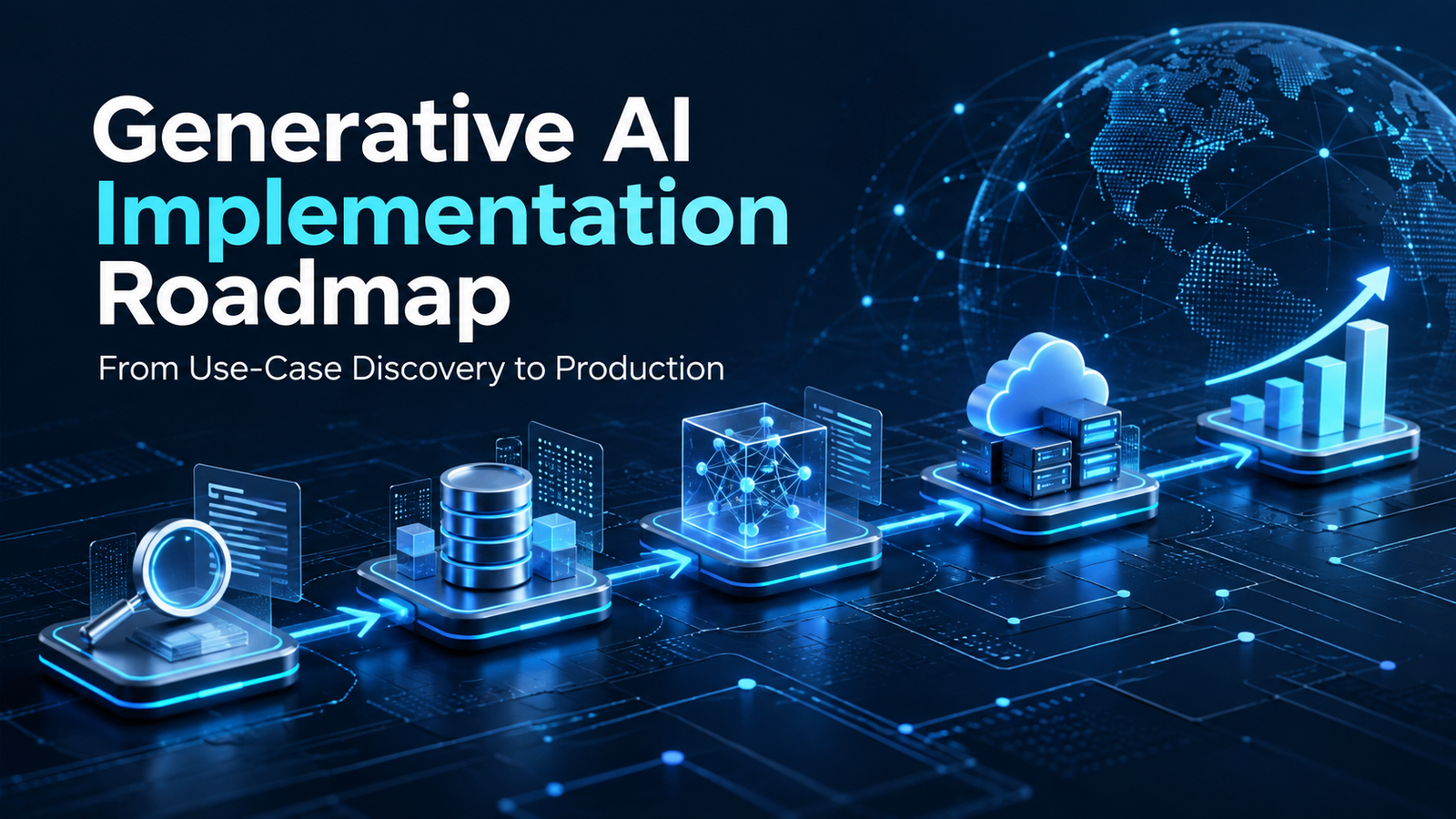
This generative AI implementation roadmap provides a structured path
from use-case discovery to production. It is designed for business
leaders, technology teams and operations owners who want to turn
generative AI into a useful business capability rather than an isolated
experiment.
What Is Generative AI Implementation?
Generative AI implementation is the process of designing, building,
integrating and operating an AI solution that can generate content or
responses based on user instructions and business context. The output
may include text, summaries, recommendations, software code, images,
reports or structured data.
IBM defines generative AI as artificial intelligence capable of
creating original content—including text, images, video, audio and
code—in response to prompts. However, an enterprise implementation
normally adds several layers around the underlying model, such as
business data, access permissions, workflow rules, monitoring and human
approval.
For example, an employee may ask a company knowledge assistant about
a policy. The visible interaction appears simple, but a production
system may need to:
- Verify the employee’s identity and access rights.
- Search approved policy documents.
- Retrieve the most relevant passages.
- Generate an answer grounded in those passages.
- Cite the source documents.
- Prevent sensitive information from being exposed.
- Record the interaction for quality and security monitoring.
- Escalate uncertain answers to a human expert.
The model is only one component. The complete business solution is
the combination of model, data, application, controls, integrations and
operating processes.
Why Generative AI Projects Fail to Reach Production
Many organisations begin with technology rather than business value.
A team selects a popular model, creates a demonstration and then
searches for a problem to solve. This reverses the correct order.
Common reasons generative AI projects stall include:
- The use case is too broad or poorly defined.
- No measurable business outcome has been agreed upon.
- Source data is incomplete, outdated or inaccessible.
- The solution is not integrated into the user’s existing
workflow. - Accuracy is assessed informally instead of through structured
evaluation. - Security, privacy and governance are considered too late.
- Costs are estimated using demo-level usage rather than production
demand. - Employees do not trust the system or understand how to use it.
- Nobody owns the product after the proof of concept ends.
The solution is not to avoid experimentation. It is to run experiments within a roadmap that defines decision gates, ownership and success criteria from the beginning.
The Eight-Stage Generative AI Implementation Roadmap
The following eight stages provide a practical framework for moving from an initial opportunity to a scalable production system.
Stage1: Define the Business Problem and Desired Outcome
Start with a business problem—not with a model or tool.
A useful problem statement identifies the affected users, the current process, the pain point and the desired improvement. Compare these two examples:
Weak objective: “We want to use generative AI in customer support.”
Stronger objective: “We want to help customer-support agents find approved answers faster, reduce average handling time and improve first-contact resolution without allowing AI to send unreviewed responses during the initial deployment.”
The stronger statement establishes a user, workflow, outcome and safety boundary. It also makes later evaluation possible.
At this stage, interview process owners and frontline users. Review operational data, customer complaints, turnaround times, error rates and repetitive activities. Look for work that involves searching, summarising, drafting, classifying or transforming large amounts of information.
Define three types of measures:
- Business metrics: revenue influenced, cost saved, turnaround time, resolution rate or conversion rate.
- User metrics: adoption, task-completion rate, satisfaction and time saved per user.
- AI quality metrics: factual accuracy, groundedness, relevance, refusal quality and unsafe-output rate.
Stage deliverable: A one-page problem definition with baseline performance, target outcome, users, process owner and constraints.
Stage2: Discover and Prioritise Generative AI Use Cases
Most organisations can identify dozens of potential use cases. The challenge is selecting the right first one.
Examples include:
- Internal knowledge assistants
- Customer-support agent assistance
- Proposal and sales-document drafting
- Contract or policy summarisation
- Product-description generation
- Meeting and call summarisation
- Document data extraction
- Software-development assistance
- Personalised marketing content
- Research and competitive-intelligence support
Score each opportunity using a consistent framework:
| Evaluation factor | Key question |
|---|---|
| Business value | Will the use case materially improve revenue, cost, speed, quality or risk? |
| Feasibility | Is the required data available and is the workflow technically achievable? |
| Risk | Could an incorrect output create financial, legal, safety or reputational harm? |
| Adoption | Will users employ the solution in their normal workflow? |
| Scalability | Can the capability expand to more teams or transactions? |
| Time to value | Can meaningful evidence be produced within weeks rather than years? |
The best first use case is rarely the most ambitious. Choose a bounded process with accessible data, frequent usage, measurable performance and a manageable consequence of error. An internal assistant that helps trained employees may be a better starting point than a fully autonomous customer-facing system.
Stage deliverable: A prioritised use-case portfolio and a clearly selected pilot use case.
Stage3: Assess Data, Technology and Organisational Readiness
Generative AI does not eliminate the need for data readiness. It makes data quality and access controls even more important.
For a retrieval-augmented generation application, assess whether the source documents are current, authoritative, searchable and owned by a responsible team. Identify duplicates, outdated policies, scanned documents, missing metadata and conflicting versions. Decide which sources the system may use and which must be excluded.
Review data across five dimensions:
- Availability: Can the project access the necessary information?
- Quality: Is the information accurate, current and complete?
- Structure: Can documents be separated, labelled and retrieved effectively?
- Permission: Which users are allowed to access each data source?
- Sensitivity: Does the data include personal, confidential, regulated or proprietary information?
Technology readiness includes identity management, APIs, cloud or on-premises infrastructure, logging, observability and integration with existing platforms. Organisational readiness includes product ownership, subject-matter experts, security participation, training and change management.
Do not upload confidential company information to consumer AI tools without approved contractual and security controls. Establish rules for sensitive data before development starts.
Stage deliverable: A readiness assessment covering data, infrastructure, integration, skills, security and governance gaps.
Stage 4: Design the Solution Architecture and Governance Model
The architecture should follow the use case instead of forcing every problem into the same design.
The main decisions include:
Select the model approach
Consider model quality, latency, language support, context length, hosting options, data-handling terms and cost. A larger model is not automatically the best model. A smaller or specialised model may be faster and more economical for a narrow task.
Decide how business knowledge will be supplied
Common options include:
- Prompt engineering: Provide instructions and examples to guide the model.
- Retrieval-augmented generation: Retrieve relevant company information at request time and provide it to the model.
- Fine-tuning: Adapt a model’s behaviour using curated examples.
- Tool use and agents: Allow the system to call approved applications, APIs or workflows.
RAG is often suitable when answers must use changing enterprise information and show sources. Fine-tuning may help with consistent style, classification or specialised behaviour, but it is not a substitute for retrieving current facts.
Establish governance before scaling
NIST’s Generative AI Profile extends the AI Risk Management Framework with considerations for generative AI risks. In practice, governance should define:
- Business and technical ownership
- Approved models and vendors
- Acceptable and prohibited uses
- Data-retention and privacy rules
- Human-review requirements
- Risk classification
- Testing and approval standards
- Incident and escalation procedures
- Monitoring and audit responsibilities
IBM describes AI governance as the standards, processes and guardrails that help AI systems remain safe, ethical and compliant. Governance should therefore operate throughout the lifecycle, not as a document written after deployment.
Stage deliverable: Target architecture, data flow, model decision, security design and governance controls.
Stage 5: Build a Focused Proof of Concept
The purpose of a proof of concept is to answer the most important uncertainties—not to simulate a finished product.
Keep the scope narrow. Use a representative subset of data and a limited group of users. Build only enough functionality to test whether the proposed approach can deliver the required quality and business outcome.
A useful generative AI PoC should include:
- A clearly defined user task
- Representative business data
- An initial prompt or retrieval strategy
- A basic but usable interface
- Logging of inputs, outputs and errors
- A test dataset with expected outcomes
- Agreed success and failure thresholds
- Feedback from actual users
Avoid judging the PoC through a handful of impressive examples. Create a structured evaluation set containing typical cases, difficult
cases, ambiguous requests, sensitive requests and cases the system should refuse.
For a knowledge assistant, evaluation may cover:
- Did it retrieve the correct source?
- Is the response supported by that source?
- Did it cite the source accurately?
- Did it avoid inventing information?
- Did it respect access permissions?
- Did it communicate uncertainty appropriately?
At the end of the PoC, make an explicit decision: proceed, revise, pause or stop. Stopping a weak use case is a successful outcome if it prevents a larger unproductive investment.
Stage deliverable: Working PoC, evaluation results, user feedback and a documented go/no-go decision.
Stage 6: Turn the PoC Into a Production-Ready Product
A PoC proves possibility. Production engineering creates reliability.
Moving into production usually requires work that was intentionally simplified during the experiment:
- Secure authentication and role-based access
- Reliable data pipelines and document updates
- Version control for prompts and configurations
- Error handling and fallback behaviour
- Response citations and user feedback mechanisms
- Content filters and policy enforcement
- Model and vendor failover where necessary
- Load, latency and concurrency testing
- Cost budgets and usage controls
- Monitoring dashboards and audit logs
- Integration with CRM, ERP, help desk or other business systems
Human oversight should match the risk. A low-risk drafting assistant may allow employees to edit the output before use. A system supporting financial, healthcare, legal or employment decisions may require stronger verification, constrained outputs and formal approval.
Create a threat model covering prompt injection, data leakage, malicious files, insecure tool calls, excessive permissions and abuse.
If the application can take actions—not merely generate text—limit each tool to the minimum permissions required and require confirmation for sensitive actions.
Estimate total operating cost, not only model-token cost. Include data processing, search infrastructure, hosting, integration,
monitoring, security, maintenance, evaluation and user support.
Stage deliverable: Production backlog, security approval, operating-cost model, service-level targets and release
plan.
Stage 7: Deploy in Phases and Drive User Adoption
Do not release a new generative AI system to the entire organisation on day one. Use controlled deployment phases.
A typical sequence is:
- Internal project team
- Selected power users
- One department or workflow
- Broader user population
- External users, if appropriate
Each phase should have entry criteria, monitoring and an exit decision. During early rollout, make it easy for users to report
incorrect, unhelpful or unsafe answers.
Adoption requires more than a launch email. Explain what the system can do, what it cannot do and when human judgement remains necessary. Provide role-specific examples and short training sessions. Identify champions within the operating team and create a process for responding to feedback.
Measure real usage rather than registrations. Important indicators include weekly active users, repeat usage, task completion, time saved, acceptance of suggested content and escalation rates.
If adoption is low, investigate the workflow before blaming users. The system may require too many steps, sit outside the applications
employees already use or fail to provide enough value compared with the existing process.
Stage deliverable: Phased rollout, training materials, support model, adoption dashboard and feedback process.
Stage 8: Monitor, Improve and Scale
Deployment is the beginning of the operating lifecycle—not the end of the project.
Generative AI performance can change because models, source documents, prompts, user behaviour and business processes change. Continuous monitoring should cover:
- Response quality and groundedness
- Retrieval quality
- Unsafe or prohibited outputs
- Latency and availability
- Model and infrastructure cost
- User adoption and satisfaction
- Business KPI improvement
- Security events and access anomalies
- Changes in source-data quality
Maintain a regression test set and run it whenever the model, prompt, retrieval process or source data changes. Version important components so the team can identify which change caused an improvement or decline.
Scale only after the first use case demonstrates value. Reusable components—identity, model gateways, evaluation tools, logging, approved connectors and governance processes—can reduce the cost and risk of later use cases.
However, avoid treating every new use case as a copy-and-paste exercise. Each workflow still needs its own risk assessment, data
permissions, evaluation dataset and outcome measures.
Stage deliverable: Monitoring framework, improvement backlog, scaling decision and reusable AI platform components.
A Practical Generative AI Implementation Timeline
Every project is different, but a bounded first implementation may
follow this indicative sequence:
| Phase | Indicative duration | Main output |
|---|---|---|
| Discovery and prioritisation | 1–3 weeks | Selected use case and success metrics |
| Readiness and solution design | 2–4 weeks | Data, architecture and governance plan |
| Proof of concept | 4–8 weeks | Tested PoC and go/no-go decision |
| Production development | 6–16+ weeks | Secure, integrated application |
| Controlled rollout | 2–6 weeks | Validated deployment and trained users |
| Continuous improvement | Ongoing | Better quality, adoption and ROI |
These ranges are planning guidance, not promises. A simple internal assistant may move faster, while a regulated or highly integrated
solution may require substantially more time.
Generative AI Implementation Team: Who Should Be Involved?
A successful initiative is cross-functional. The core team commonly
includes:
- Executive sponsor: Removes organisational barriers and connects the project to strategy.
- Product owner: Owns the problem, priorities, users and business results.
- Subject-matter experts: Validate data, outputs and real-world usefulness.
- AI or machine-learning engineers: Develop model, retrieval and evaluation components.
- Application and integration engineers: Connect the solution to business systems.
- Data engineers: Prepare, secure and maintain enterprise information.
- Security, privacy and legal teams: Define controls and assess risk.
- UX and change specialists: Improve usability, training and adoption.
- Operations owner: Runs monitoring, support and continuous improvement after launch.
Small organisations may combine several roles, but the responsibilities should still be explicit. A project without a committed
business owner often becomes a technical demonstration with no path to sustained adoption.
How to Measure Generative AI ROI
Measure value against the original baseline. Do not count every generated response as a benefit.
For an employee assistant, a simple annual productivity estimate may be:
Annual time value = users × tasks per month × minutes saved per task × 12 × loaded hourly cost ÷ 60
Then subtract annual operating and maintenance costs. Where possible, validate whether saved time becomes productive capacity, faster service or reduced external expenditure.
Also measure quality and risk. A solution that saves time but increases corrections, complaints or compliance exposure may have
negative overall value.
Track benefits such as:
- Reduced handling or research time
- Faster document turnaround
- Increased employee capacity
- Higher conversion or response rates
- Lower error and rework rates
- Improved customer or employee satisfaction
- Reduced compliance or operational risk
ROI should be reviewed after controlled deployment and again after wider adoption. Early estimates are hypotheses; production data provides the evidence.
Generative AI Implementation Checklist
Before approving production deployment, confirm that:
- The business problem and target KPI are documented.
- A named business owner is accountable for the outcome.
- Users have participated in design and testing.
- Approved data sources and permissions are defined.
- Privacy and security reviews are complete.
- Model selection is based on quality, risk, latency and cost.
- Test cases represent real, difficult and unsafe scenarios.
- Human oversight matches the consequence of error.
- The solution is integrated into the actual workflow.
- Production cost and usage limits are understood.
- Monitoring, incident response and rollback processes exist.
- Employees know the system’s limitations.
- A post-launch improvement owner and budget are assigned.
Frequently Asked Questions
How should a company start implementing generative AI?
Start by identifying a specific, measurable business problem. Prioritise a bounded use case with available data and manageable risk,
then run a focused proof of concept with predetermined success criteria. Do not begin by buying a platform without knowing which process it will improve.
How long does generative AI implementation take?
A focused PoC may take four to eight weeks after discovery and readiness work. Production deployment commonly requires additional months depending on data quality, security, integration, regulatory requirements and the number of users. Complex enterprise programmes should use phased releases.
What is the difference between a generative AI PoC and production deployment?
A PoC tests whether an approach can work for a limited scenario. A production deployment must operate reliably for real users and includes authentication, permissions, monitoring, integration, error handling, support, security controls and ongoing maintenance.
Does every generative AI project require fine-tuning?
No. Many projects can begin with prompt engineering and retrieval-augmented generation. Fine-tuning is useful for particular behaviours or specialised tasks, but it should be selected only after the team understands the gap it needs to solve.
How can businesses reduce generative AI hallucinations?
Use authoritative data sources, retrieval grounding, clear instructions, structured outputs, citations, validation rules and human
review. Test the system against a representative evaluation set and design it to express uncertainty or refuse unsupported requests.
What is the biggest risk when implementing generative AI?
There is no single risk for every use case. Common risks include confidential-data exposure, unsupported outputs, biased responses,
insecure integrations, excessive automation and unclear accountability. Risk controls should reflect the users, data and consequence of an incorrect action.
From AI Experimentation to Measurable Business Value
Generative AI implementation succeeds when technology, data, people and governance are designed together. The strongest programmes do not attempt to transform every process immediately. They select a valuable use case, establish evidence through a controlled PoC, engineer the solution for production, deploy it in phases and improve it using real performance data.
The key question is not whether your organisation should use generative AI. It is where generative AI can produce a measurable
improvement with an acceptable level of risk—and what capabilities are required to deliver that improvement reliably.
AI Growth Circuit helps organisations move from opportunity discovery to production implementation through AI strategy consulting, AI readiness assessment, generative AI consulting, PoC development, AI integration and AI governance.
Ready to identify the right generative AI use case for your business? Book an AI
discovery call to develop a practical implementation roadmap.