
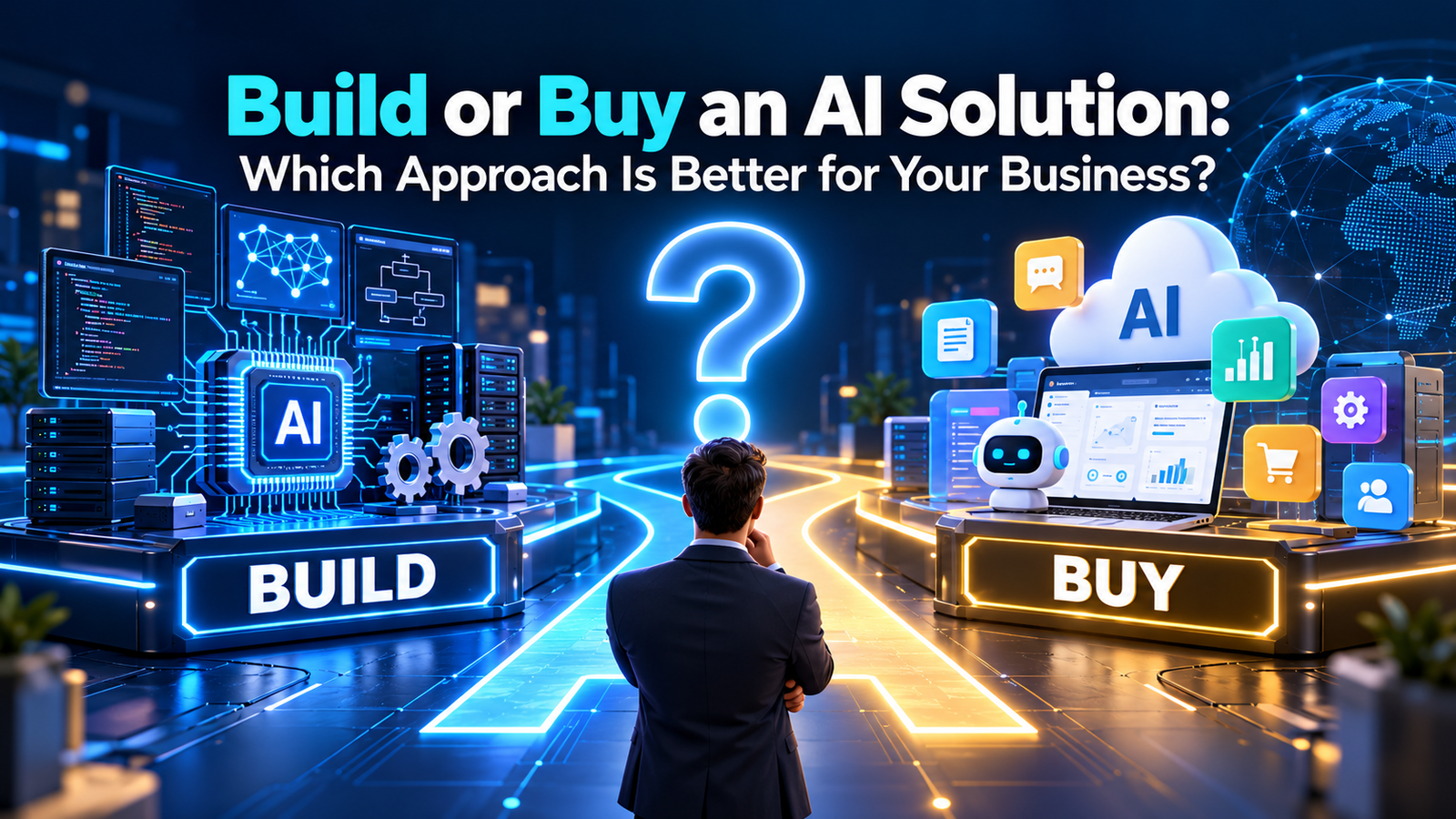
Artificial intelligence is becoming part of everyday business operations. Companies are using AI to automate repetitive work, support employees, improve customer experiences, analyze information, and make faster decisions.
As AI becomes easier to access, an important question emerges: should a business build its own AI solution or buy an existing one?
There is no universal answer. The right choice depends on the business problem, level of customization, available expertise, data requirements, security expectations, budget, implementation timeline, and the competitive advantage the organization wants to create.
Why the Build or Buy Decision Matters
An AI investment is more than a software purchase. It can influence business processes, employee responsibilities, customer experiences, data architecture, and long term technology costs.
Choosing the wrong approach can create unnecessary development costs, slow implementation, vendor dependency, integration problems, or a solution that employees do not use effectively.
Choosing the right approach can help a business achieve faster automation, better productivity, lower operating costs, improved customer service, and stronger decision making.
The decision should therefore begin with the business outcome rather than the technology.
AI Adoption Is Already Broad
AI is no longer limited to technology companies. Organizations across industries are using AI in functions such as marketing, sales, customer service, software development, operations, finance, and knowledge management.
Stanford HAI reports that 88% of surveyed organizations use AI in at least one business function, while generative AI is used in at least one business function at 70% of organizations.
This level of adoption makes the build versus buy decision increasingly important. Businesses need to determine which AI capabilities should be treated as standard tools and which ones should become proprietary business capabilities.
What Does It Mean to Build an AI Solution?
Building an AI solution means developing technology around your organization’s specific requirements. This may involve internal developers, an external technology partner, or a combination of both.
Building does not necessarily mean creating an AI model from scratch. A company can use existing models, APIs, cloud services, databases, and open source technologies while building its own application, workflows, integrations, data layer, and business logic.
- A private AI assistant connected to internal knowledge
- A customized customer service system
- A proprietary recommendation engine
- An AI forecasting or analytics platform
- A document processing system designed for a specific industry
- An AI agent that performs specialized internal workflows
Advantages of Building an AI Solution
1. Greater Customization – A custom solution can be designed around the exact way your business operates. This is useful when standard software cannot support specialized workflows or when the process itself creates competitive value.
2. More Control over Data – Building can provide greater control over data processing, storage, access, integrations, and system architecture. This can be particularly valuable when the business handles proprietary or sensitive information.
3. Deeper Integration – A custom system can be designed to work closely with CRM platforms, ERP systems, internal databases, customer portals, knowledge bases, and other business applications.
4 – Competitive Differentiation – If AI directly improves your product, service, pricing, customer experience, or operational advantage, owning more of the solution may create value that cannot be easily replicated by purchasing the same software as competitors.
5 – Long Term Flexibility – A well planned architecture can allow the organization to change models, providers, data sources, workflows, and interfaces as requirements evolve.
Disadvantages of Building an AI Solution
1 – Higher Development Effort – Building an AI solution requires planning, development, testing, integration, and ongoing improvements. This can require significant involvement from technical and business teams.
2 – Ongoing Maintenance – A custom AI solution needs continuous monitoring, updates, testing, security improvements, and technical support. The business remains responsible for keeping the solution reliable and useful.
3 – Greater Technical Responsibility – Building an AI solution requires access to people with suitable skills in software development, AI, data management, security, and system integration. Finding and retaining these skills can be challenging.
4 – Longer Implementation Process – A custom solution usually takes more time to plan, develop, test, and deploy than configuring an existing AI product. This may delay the point at which the business starts receiving value from the solution.
5 – Higher Management Complexity – A custom AI project involves decisions about architecture, data, security, integrations, testing, monitoring, and future development. Without clear ownership and planning, the project can become difficult to manage.
What Does It Mean to Buy an AI Solution?
Buying an AI solution means adopting an existing product or platform developed by an external provider. The vendor typically manages much of the underlying software, infrastructure, updates, and maintenance. This allows businesses to access AI capabilities without taking responsibility for building the entire technology from the ground up.
The business generally focuses on selecting the right product, configuring it according to its needs, connecting it with existing systems, training users, establishing governance, and measuring business results. The goal is to choose a solution that can deliver useful business outcomes without creating unnecessary technical complexity.
AI solutions are now available for a wide range of business functions. Depending on the organization’s needs, businesses can buy solutions for areas such as:
- AI customer service platforms that help manage customer questions, support requests, and routine interactions
- AI productivity assistants that help employees with tasks such as writing, summarization, research, and everyday work
- AI marketing and sales platforms that support content creation, customer engagement, lead management, and sales activities
- AI analytics software that helps businesses analyze information, identify patterns, and support decision making
- AI recruitment solutions that assist with candidate sourcing, screening, communication, and recruitment workflows
- AI document processing platforms that help extract, organize, classify, and process information from business documents
- AI coding and development tools that support software developers with coding, testing, documentation, and development tasks
- AI knowledge management products that help employees find and use information stored across business documents and internal resources
The key advantage of buying is that much of the underlying technology is already available. Businesses can therefore focus on choosing, implementing, and using the solution rather than building every component themselves.
Advantages of Buying an AI Solution
1 – Faster Implementation – An established product can significantly reduce the time required to move from evaluation to deployment, especially when the business problem is common and well understood.
2 – Lower Initial Development Burden – Buying can eliminate the need to create an entire technology stack internally. This can be useful for businesses that have limited AI engineering resources.
3 – Vendor Expertise – Specialized vendors invest in product development, infrastructure, integrations, security, and AI capabilities. Customers can benefit from this expertise without building the entire team themselves.
4 – Continuous Product Improvements – AI products evolve quickly. A reputable vendor can provide new features, model improvements, integrations, and performance enhancements as the technology develops.
5 – Easier Scaling – Many cloud based platforms are designed to support growing usage, making them practical for businesses that want to expand without managing all infrastructure themselves.
Disadvantages of Buying an AI Solution
1 – Limited Customization – A purchased AI solution is designed to serve a broad range of businesses. While many products offer configuration options, they may not support every specific workflow or requirement of your organization.
2 – Vendor Dependency – When you buy an AI solution, you depend on the provider for product updates, technical support, new features, and important changes to the platform. Changes in the provider’s product direction can affect your business.
3 – Integration Challenges – An AI product may not connect perfectly with your existing systems. Additional development or configuration may be required to connect the solution with your CRM, ERP, website, internal applications, or other business tools.
4 – Less Control – Buying a solution means accepting the provider’s architecture, product limitations, security processes, and development roadmap. Your business may have less control over how certain features work compared with a custom solution.
5 – Ongoing Subscription and Operating Costs – The cost of an AI product can continue as long as the business uses the solution. Additional expenses may also arise from integrations, premium features, implementation services, training, or increased usage.
When Should Your Business Build AI?
Building an AI solution can be a strong choice when the technology is closely connected to your business strategy and gives you capabilities that are difficult to achieve with an existing product. In this situation, a custom solution can provide greater control over how AI works within your business and how it supports your customers, employees, and internal operations.
Building can also make sense when your business has unique workflows, proprietary information, or specialized processes that standard AI products cannot handle effectively. Instead of changing your business processes to fit an existing tool, a custom solution allows the technology to be designed around the way your organization actually works.
However, building AI also requires a long term commitment. Your business needs the technical resources, ownership, maintenance process, security controls, and development capabilities required to keep the solution reliable as your needs change.
Building is generally more attractive when:
- Your workflows are highly specialized
- Your proprietary data creates significant value
- AI is part of your core product or service
- You need deep integration with internal systems
- You require substantial customization
- You need greater control over architecture and data
- Existing products cannot satisfy critical requirements
- You have the resources to maintain the solution over time
A useful rule is: build the capabilities that make your business meaningfully different.
When Should Your Business Buy AI?
Buying an AI solution is often the more practical choice when the business need is common and established products already provide the required functionality. Instead of investing time and resources in developing the technology internally, your business can use an existing solution and focus on applying it effectively to its operations.
This approach can be particularly useful when speed is important or when your internal team has limited AI and software development expertise. A suitable AI product can provide the required capabilities without requiring your business to manage the entire development, infrastructure, testing, and maintenance process.
Buying also allows businesses to experiment with AI before making a larger custom investment. If a purchased solution proves valuable and the business later needs greater customization or deeper integration, the company can then consider building additional capabilities around it.
Buying is generally more attractive when:
- You need the solution quickly
- The problem is common across many organizations
- Existing products meet most of your requirements
- Your internal AI expertise is limited
- The capability is operational rather than strategic
- You prefer vendor managed maintenance and updates
- You want to test an AI use case before making a larger custom investment
For example, a business that needs meeting summaries, basic content assistance, standard document extraction, or a conventional customer support assistant may gain little from building the entire platform internally.
Build vs Buy: A Practical Comparison
| Factor | Build | Buy |
| Customization | Very high | Usually limited to supported options |
| Implementation speed | Usually slower | Usually faster |
| Technical responsibility | Higher internal responsibility | More responsibility handled by provider |
| Integration | Can be designed around internal systems | Depends on available integrations |
| Control | Greater control over design and workflow | Control depends on provider |
| Maintenance | Business or development partner manages it | Mostly handled by provider |
| Competitive differentiation | Strong potential | Depends on product uniqueness |
| Vendor dependency | Lower for core application ownership | Higher |
| Best fit | Unique and strategic requirements | Common and well defined requirements |
How AI Is Changing the Traditional Build vs Buy Decision
AI is also changing the economics of software development. Businesses can now use AI assisted development tools to create certain internal applications and features faster than traditional development approaches.
McKinsey reports that nearly one third of respondents, 32%, said their organizations had decided against purchasing at least one software product or feature because they could build the functionality internally using agentic coding tools.
This does not mean that companies should build everything themselves. It means the decision should be reviewed more carefully. A capability that was previously too expensive to build may now be feasible, while a standardized capability may still be far more efficient to purchase.
Questions to Ask Before Buying AI
- Does the product solve the actual business problem?
- How much customization is possible?
- How does it integrate with existing systems?
- How is business data handled?
- What happens if pricing changes?
- Can data be exported?
- What support is included?
- How often is the product updated?
- How often is the product updated?
- What happens if we want to change providers?
Questions to Ask Before Building AI
- What specific business outcome are we targeting?
- Does custom development create a meaningful advantage?
- Do we have sufficient quality data?
- Do we have the right technical expertise?
- What is the total cost of ownership?
- How long will development take?
- Who will maintain the system?
- How will AI performance be measured?
- Can the architecture evolve as AI technology changes?
- Which components could be purchased instead?
A Simple Decision Framework
Use the following questions to narrow the decision.
- Is the capability strategically important to our business?
- Is the workflow unique?
- Does our proprietary data create an advantage?
- Do we need extensive customization?
- How quickly do we need the solution?
- Do we have the technical skills to build and maintain it?
- Would buying create unacceptable vendor dependency?
- Would building create unnecessary complexity?
- What is the three year total cost of each option?
- Which option gives us the strongest measurable business outcome?
Common Mistakes Businesses Make
1 – Building Because AI Is Popular – A custom AI project should solve a real business problem. Technology ambition should not become the reason for development.
2 – Buying Without Testing – A product demonstration may look impressive but does not guarantee performance with your data, users, workflows, and integrations. Test the solution using realistic business scenarios.
3 – Ignoring Integration – An AI product that cannot work smoothly with existing systems can create additional manual work and reduce its expected value.
4 – Looking Only at Initial Price – The lowest purchase price or development estimate does not necessarily represent the lowest long term cost.
5 – Ignoring Adoption – An AI solution creates value only when employees and customers can use it effectively. Training, workflow design, and change management should be part of the plan.
6 – Automating a Poor Process – AI should not simply be added to an inefficient workflow. First understand the process, then determine where AI can improve it.
Conclusion:
The build versus buy decision is ultimately a business strategy decision.
If an existing AI product solves the problem effectively, buying can help the organization move faster while reducing development responsibility.
If the AI capability is unique, strategic, and closely connected to competitive advantage, building may provide greater long term value.
For many businesses, the strongest answer will be a combination of both. Buy the capabilities that are standardized. Build the capabilities that make your business different.
When the decision is based on business value rather than technology hype, AI becomes much more than a new tool. It becomes a practical part of the company’s growth and operating strategy.
Frequently Asked Questions
Is it cheaper to build or buy an AI solution?
Buying is often less expensive initially, but the answer depends on customization, usage, integration, maintenance, and long term vendor costs. Compare total cost of ownership rather than the initial price.
When should a company build its own AI?
Consider building when AI is strategically important, proprietary data or workflows create an advantage, or existing products cannot meet critical requirements.
When should a company buy AI software?
Buying is generally preferable when the problem is common, a mature product already exists, rapid deployment matters, or the organization does not want to maintain the technology internally.
Can a company combine build and buy?
Yes. A hybrid strategy can use purchased AI infrastructure and models while the company builds its own workflows, integrations, business logic, and user experience.
What is the biggest mistake in the build versus buy decision?
Focusing on technology before defining the business outcome. The decision should be based on value, cost, risk, speed, and strategic importance.
Still Not Sure Whether to Build or Buy Your AI Solution?
Choosing between building a custom AI solution and buying an existing platform can be challenging. We help businesses evaluate their requirements, technology needs, integration challenges, and long term goals to identify the right approach.
We help organizations across financial services, retail & ecommerce, manufacturing, and SaaS make smarter AI decisions and move confidently from strategy to implementation.
Need help making the right AI decision? Book an AI Consultation.