
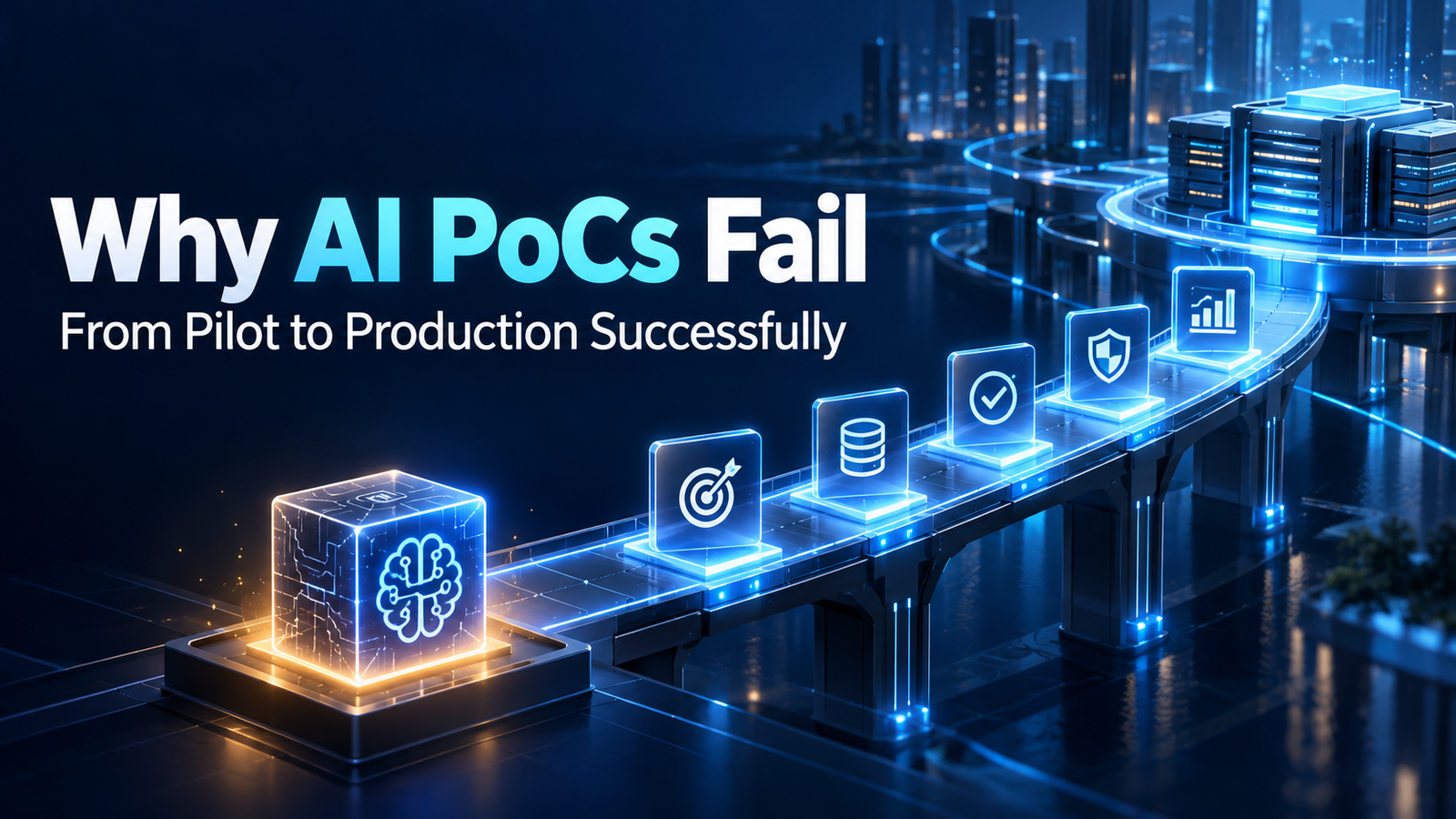
An AI proof of concept can be built quickly. A team selects a promising model, connects a small set of documents, writes several prompts and demonstrates an impressive answer. Stakeholders become excited, the presentation is declared successful—and then the project stops.
The problem is not necessarily that the model failed. The PoC may have proved that a capability is technically possible while leaving the organisation unable to answer the questions that determine production viability:
- Does the solution improve a measurable business outcome?
- Does it work on representative data and difficult cases?
- Can it integrate reliably with real business systems?
- Is its accuracy acceptable for the consequence of an error?
- Can sensitive information be protected?
- Who approves, monitors and maintains the system?
- Will the unit economics remain viable at production volume?
- What happens when a model, API, data source or policy changes?
AWS Prescriptive Guidance makes an important distinction: a PoC should be a rigorous experiment that reduces investment risk, not merely a technical demonstration designed to impress. It should validate business value, data readiness, technical feasibility and delivery risks before the organisation commits to production.
Moving from pilot to production therefore requires more than improving prompts. It requires product ownership, evaluation, architecture, integration, security, governance, change management and an operating model.
This guide explains why AI PoCs fail and provides a practical framework for turning a successful experiment into a reliable production system.
What Is an AI Proof of Concept?
An AI proof of concept is a time-bound experiment used to test the most important assumptions behind a proposed AI solution.
Depending on the use case, a PoC may test whether a system can:
- Classify customer enquiries accurately
- Extract fields from invoices or contracts
- Retrieve relevant information from company documents
- Draft responses grounded in approved knowledge
- Summarise meetings into structured CRM fields
- Forecast demand or identify anomalies
- Use tools to complete a limited multi-step workflow
A PoC is not a production application. It may use a small dataset, limited integrations, manual workarounds, test users and simplified infrastructure. That is acceptable if those limitations are documented and the experiment is designed to produce a clear decision.
The real output of a PoC is not the demo. It is evidence supporting one of three decisions:
- Proceed: the business case and technical path are sufficiently strong.
- Pivot: the opportunity remains valuable, but the workflow, model, data or scope must change.
- Stop: the expected value does not justify the risk or investment.
Why a Successful Demo Is Not a Production-Ready System
A demo shows selected inputs under controlled conditions. Production exposes the application to varied users, incomplete information, changing data, peak traffic, malicious inputs, system outages and business exceptions.
| PoC environment | Production environment |
|---|---|
| Curated examples | Diverse and unpredictable inputs |
| Small number of users | Concurrent users with different permissions |
| Manual preparation | Automated ingestion and validation |
| One model and prompt version | Versioned models, prompts and configurations |
| Limited or mocked integrations | Live CRM, ERP, helpdesk and identity systems |
| Best-case workflow | Exceptions, retries, timeouts and partial failures |
| Informal review | Defined approvals, auditability and accountability |
| Short experiment | Continuous operation and maintenance |
| Approximate cost | Measured unit economics and budgets |
| Demonstrated output | Measurable business outcome |
This gap explains why an apparently successful AI pilot can still be unsuitable for release.
13 Reasons AI PoCs Fail
1. The PoC Starts With Technology Instead of a Business Problem
Many projects begin with a request to “use generative AI” or “build an AI agent.” The team selects technology before defining the decision, delay or cost that needs improvement.
Without a clear business objective, the PoC is evaluated on whether the output looks intelligent. Stakeholders may like the demo without knowing whether it is valuable enough to fund, adopt or maintain.
A stronger starting statement is specific:
Reduce the average time required to prepare a first response to eligible support emails from 12 minutes to 5 minutes, while maintaining approved quality and escalation standards.
This connects the system to a workflow, user, baseline, target and quality constraint.
Production fix: define the current baseline, target outcome, process owner and financial or operational value before selecting the model.
2. Success Criteria Are Vague or Defined After Testing
If the team does not define success before building, it can select the most favourable examples after the experiment. “The responses were good” is not a reliable acceptance criterion.
A PoC needs business, model, system and risk metrics. For a knowledge assistant, these may include answer correctness, citation validity, retrieval relevance, unsafe-response rate, response time, cost per interaction and user task completion.
AWS recommends connecting business goals to technical measures and defining explicit exit criteria for quality, latency and cost. A PoC should be able to fail honestly. Otherwise, it cannot reduce decision risk.
Production fix: create a signed measurement plan with thresholds for proceed, pivot and stop before the main experiment begins.
3. The Test Data Does Not Represent Production Reality
Teams often evaluate a model using a few clean examples created by the same people who built the solution. Those examples may omit incomplete requests, unusual terminology, outdated files, multilingual content, scanned documents, conflicting policies and adversarial inputs.
The result is a system that performs well in a presentation but breaks when users behave normally.
OpenAI’s evaluation guidance warns against evaluation datasets that do not reproduce production traffic patterns. A useful test set should include common cases, important edge cases, known failures and examples representing different users, channels and data qualities.
Production fix: build a versioned evaluation dataset from historical cases, subject-matter expert examples and controlled synthetic data. Keep a separate holdout set for final validation.
4. Data Readiness Is Assumed Rather Than Tested
An AI application may depend on documents that are duplicated, obsolete, contradictory, poorly structured or inaccessible. A retrieval system cannot reliably answer questions if ownership and freshness of the source material are unclear.
Data problems also appear as permission problems. The PoC may use exported files, while production must respect document-level access, retention rules, customer boundaries and data residency.
AWS recommends assessing data availability, accessibility, quality, lineage, freshness and subject-matter validation during the PoC. These are not cleanup tasks to postpone until deployment.
Production fix: define authoritative sources, owners, refresh schedules, access rules and quality checks. Measure retrieval performance separately from response quality.
5. The PoC Is Built Outside the Real Workflow
A standalone chat interface can be useful for testing, but employees may need the capability inside a CRM, helpdesk, ERP, document system or operational dashboard.
If the pilot requires users to copy information between tools, re-enter data or abandon their normal process, adoption will be weak. Integration constraints can also change feasibility: the target application may lack an API, enforce rate limits or require complex identity controls.
Production fix: validate at least one critical integration during the PoC. Map triggers, inputs, decisions, approvals, actions and system records from end to end—even if some steps remain manual during the experiment.
6. The Team Optimises Model Accuracy but Ignores the Whole System
AI application quality depends on more than the model. A response may be wrong because the wrong document was retrieved, the user’s permissions were not applied, a tool returned stale data, an output parser failed or a business rule was missing.
Testing only the final answer hides the source of failure. Production teams need component-level and end-to-end evaluation.
For a retrieval-augmented generation application, evaluate document ingestion, chunking, retrieval, ranking, grounding, answer quality and citations. For an agent, evaluate tool selection, parameters, handoffs, approvals and stopping behaviour.
Production fix: trace the complete workflow and assign metrics to the model, retrieval, tools, rules and user experience.
7. Security, Privacy and Compliance Are Deferred
Teams sometimes use real customer or employee data in a loosely controlled PoC because it is faster. This can create exposure before the project has formal approval.
Production introduces additional risks: prompt injection, excessive tool permissions, sensitive-data leakage, insecure logs, cross-tenant access and unapproved actions. An AI agent that can read and act across systems requires stronger controls than a text generator.
NIST’s AI Risk Management Framework is designed to incorporate trustworthiness considerations into the design, development, use and evaluation of AI systems. Security and governance should therefore shape the PoC—not appear as a checklist immediately before launch.
Production fix: conduct data classification and threat modelling early. Apply least privilege, authentication, encryption, secret management, input validation, content controls, approval gates and audit logging.
8. Human Oversight Is Undefined
“A human will review it” sounds safe but is incomplete. Which person reviews the output? What evidence will they see? How quickly must they respond? Can they edit or reject the result? Who is accountable if they approve an incorrect action?
Reviewers can also develop automation bias and accept plausible outputs without checking them. If the system processes too many cases, the human checkpoint may become a bottleneck or a superficial click.
OpenAI’s agent guidance treats human intervention and guardrails as important parts of production safety. Oversight should be triggered according to confidence, risk and consequence.
Production fix: define review queues, authority levels, escalation rules and maximum workload. Show reviewers the original evidence, AI recommendation, confidence information and proposed action.
9. Unit Economics Are Calculated Too Late
A PoC with 100 interactions can appear inexpensive. Production cost may increase because the system uses longer context, multiple model calls, retrieval, reranking, document processing, tool calls, retries, observability and human review.
The relevant question is not simply the monthly API bill. It is the cost per successfully completed business outcome at expected volume.
Estimate:
- Model input and output usage
- Embeddings, reranking and search
- Hosting, databases and storage
- Third-party APIs
- Monitoring and security
- Failed requests and retries
- Human review and exception handling
- Maintenance and support
Production fix: measure unit cost during the PoC using representative workflows, then model low, expected and peak volumes.
10. The Architecture Is a Prototype That Cannot Be Operated
Prototype code may contain hard-coded prompts, shared credentials, manual file uploads and limited error handling. Releasing the same implementation can create reliability and security problems.
A production design needs modular services, environment separation, version control, deployment pipelines, retry behaviour, rate-limit management, caching, fallback options, backups and disaster recovery appropriate to the use case.
Google Cloud advises organisations to consider the platform capabilities required to develop, deploy and manage AI at scale, rather than evaluating a model in isolation.
Production fix: treat the PoC as learning, not as the final architecture. Document which components can be retained and which must be rebuilt for preproduction.
11. There Is No Product Owner or Operating Model
AI projects can fall between the business, IT, data and innovation teams. The business expects engineering to own quality; engineering expects the business to own knowledge; no one owns adoption, feedback or ongoing cost.
A production system needs named accountability for:
- Business outcomes
- Product backlog and prioritisation
- Data and knowledge sources
- Model and prompt versions
- Security and risk decisions
- User support and training
- Incident response
- Vendor and cost management
Production fix: assign one accountable business product owner supported by a cross-functional team. Establish decision rights before the production build.
12. Users Are Introduced Too Late
Technical teams may build an AI solution based on assumptions about how employees work. During the pilot, users discover that the output is difficult to verify, arrives too late or omits information required for a decision.
Adoption depends on trust and workflow fit, not just accuracy. Users need to understand what the system can do, where it may fail and how to provide feedback.
Production fix: involve representative users in discovery, evaluation and interface design. Run a controlled pilot with real tasks, measure completion and collect structured feedback—not only satisfaction comments.
13. The Organisation Has No Plan for Monitoring and Change
AI behaviour can change when the model version, prompt, retrieval corpus, integration or user population changes. A system that passed a one-time test can degrade later.
Google, Microsoft and OpenAI all provide guidance around evaluation and production monitoring. Useful monitoring covers model quality, safety, latency, availability, usage, cost, retrieval and tool failures.
Production fix: reuse development evaluations in deployment pipelines, sample production interactions for quality review, detect operational anomalies and define rollback procedures.
A Practical Framework for Moving From AI PoC to Production
The transition should be treated as a series of evidence-based gates rather than one large implementation commitment.
Stage 1: Reconfirm the Business Case
Document the workflow, current baseline, target users and expected benefit. Update the original business case using what the PoC revealed.
Answer:
- What decision or task will improve?
- How frequently does it occur?
- What is the current time, cost, error or delay?
- What outcome will the production system change?
- What new review or operating cost will it create?
Gate: proceed only if the expected benefit remains material after including production and review costs.
Stage 2: Make a Formal Go, Pivot or Stop Decision
Compare results with the success thresholds defined before testing. Include quantitative metrics, user feedback, technical constraints, risks and unit economics.
AWS describes this as a formal decision gate based on business value, technical viability, ROI and strategic alignment. Continuing because the team has already invested time is not a valid reason.
| Decision | When it is appropriate | Next action |
|---|---|---|
| Proceed | Core assumptions met and production path is clear | Build preproduction plan |
| Proceed with conditions | Value proven but specific gaps remain | Fund limited remediation milestones |
| Pivot | Problem is valuable but approach or scope failed | Redesign and retest critical assumption |
| Stop | Value, feasibility, economics or risk is unacceptable | Document learning and close initiative |
Stage 3: Convert the PoC Into Product Requirements
The production scope should describe more than AI features. Define:
- User roles and permissions
- Supported and unsupported tasks
- Required data sources
- Integrations and write actions
- Response-time and availability targets
- Confidence and escalation behaviour
- Human approval steps
- Audit and reporting requirements
- Data retention and residency
- Expected transaction volumes
- Support and incident procedures
This prevents the team from treating the prompt as the product specification.
Stage 4: Build a Production Evaluation System
Create a versioned “golden” evaluation set representing real traffic. Include common cases, high-impact edge cases, adversarial inputs and known failure patterns.
Evaluation may combine:
- Deterministic checks for format and required fields
- Reference-based scoring
- Model-based graders with calibration
- Subject-matter expert review
- Pairwise comparisons between versions
- End-to-end task completion
- Security and red-team testing
OpenAI recommends continuous, task-specific evaluation and notes that test inputs should reflect production use. The evaluation suite should run when prompts, models, retrieval logic, tools or policies change.
Stage 5: Design the Production Architecture
Replace shortcuts with controlled components:
- Identity and access: authenticate users and apply role-based permissions.
- Data layer: use governed sources, lineage, freshness and access filtering.
- Model gateway: control approved models, budgets, rate limits and version changes.
- Prompt and configuration management: version system instructions, schemas and policies.
- Retrieval or tools: validate inputs, outputs, permissions, timeouts and retries.
- Guardrails: apply deterministic rules, content controls and human approvals.
- Observability: log traces, latency, cost, failures and quality signals safely.
- Application layer: deliver a usable interface inside the target workflow.
- Deployment pipeline: test and release changes consistently across environments.
Choose the simplest architecture that meets the requirements. A single controlled workflow is often more reliable than an unnecessary multi-agent system.
Stage 6: Complete Security and Governance Reviews
Create a use-case risk assessment covering:
- Data sensitivity and lawful use
- User identity and permissions
- Third-party model and vendor handling
- Prompt injection and tool abuse
- Bias and unfair outcomes
- Intellectual property and confidentiality
- Incorrect or unsupported outputs
- Financial, legal, safety and reputational impact
- Logging, retention and auditability
- Incident response and human escalation
Define prohibited actions and conditions that require approval. Record who accepted residual risk and why.
Stage 7: Run a Controlled Production Pilot
Move beyond the laboratory without exposing the system to the entire organisation. Select a representative group of users, limited workflows and reversible actions.
Use deployment patterns such as:
- Shadow mode: the AI produces recommendations without affecting the live workflow.
- Assistive mode: users review every output before it is used.
- Limited autonomy: only low-risk, high-confidence cases are completed automatically.
- Phased rollout: expand by team, region, product or transaction type.
Measure user behaviour as well as technical quality. Determine whether employees use, correct, ignore or work around the system.
Stage 8: Establish Production Monitoring and Improvement
Create dashboards and alerts covering four dimensions:
Business Outcomes
- Time or cost saved
- Conversion or resolution improvement
- Capacity created
- Customer or employee satisfaction
AI Quality
- Correctness and groundedness
- Retrieval relevance
- Citation validity
- Tool-selection accuracy
- Human correction and rejection rates
Operations
- Availability and error rate
- Latency percentiles
- Integration failures
- Queue size and review time
Risk and Cost
- Unsafe or policy-violating output
- Escalations and incidents
- Token and infrastructure cost
- Cost per successful task
Set thresholds, owners and response procedures. Monitoring without assigned action is only reporting.
AI PoC Production-Readiness Checklist
Use this checklist before approving a transition to production.
Business Readiness
- Named business owner and executive sponsor
- Baseline and target business outcome documented
- Expected benefit and total cost model updated
- Clear go, pivot and stop criteria
- User workflow and adoption plan validated
Data Readiness
- Authoritative data sources identified
- Data owners and refresh schedules assigned
- Access controls and data lineage documented
- Representative evaluation data approved
- Sensitive data handling reviewed
Technical Readiness
- Target integrations tested
- Production architecture reviewed
- Load, latency and concurrency tested
- Error handling, retries and fallbacks implemented
- Model, prompt and configuration versions controlled
- Deployment and rollback process tested
Quality and Safety Readiness
- Task-specific evaluation thresholds met
- Edge cases and adversarial inputs tested
- Guardrails and approval gates validated
- Unsupported scenarios trigger safe escalation
- Human reviewers have evidence and clear authority
Operational Readiness
- Logs, traces and dashboards available
- Cost and usage limits configured
- Support team and incident process prepared
- Production feedback loop established
- Maintenance budget and roadmap approved
Metrics That Should Determine Production Approval
The exact thresholds depend on the consequence of error. A creative drafting assistant and an automated payment workflow should not share the same acceptance criteria.
| Metric category | Example measures | Key question |
|---|---|---|
| Business | Cycle time, cost per task, conversion, capacity | Does it create meaningful value? |
| Quality | Accuracy, groundedness, completeness, extraction F1 | Is the output good enough for the task? |
| User | Task completion, adoption, correction rate, satisfaction | Will people use it successfully? |
| Risk | Unsafe output, policy breach, bias, escalation accuracy | Is residual risk acceptable? |
| Technical | Latency, uptime, tool success, failure recovery | Can the system operate reliably? |
| Economics | Cost per successful task, review cost, peak spend | Is it financially viable at scale? |
Avoid declaring a project successful because one metric improved. A faster system that increases errors or review time may not create net value.
Who Should Be Involved in the Transition?
Production AI is cross-functional. A typical team includes:
- Business product owner: accountable for value, scope and adoption
- Subject-matter experts: define correct outputs and review cases
- AI or data team: model selection, evaluation and improvement
- Software engineering: integrations, application and reliability
- Security and privacy: threat modelling, access and data controls
- Legal or compliance: regulatory, contractual and policy review
- Operations or support: monitoring, incidents and user assistance
- Finance or procurement: budgets, vendors and unit economics
- Change-management lead: training, communication and feedback
The exact roles vary by risk and organisation size, but accountability must remain explicit.
Frequently Asked Questions
Why do most AI PoCs fail to reach production?
Common causes include weak business alignment, unrepresentative test data, poor integration planning, unclear success criteria, missing security controls, untested economics and no accountable product owner. Many PoCs prove model capability without proving operational viability.
What is the difference between an AI PoC and an AI pilot?
A PoC tests critical assumptions in a limited environment. A pilot places a more complete solution with representative users and real workflows under controlled conditions. The pilot evaluates usability, operations and adoption before broader deployment.
How long should an AI PoC take?
A focused PoC often takes approximately four to eight weeks after discovery, but the appropriate duration depends on data, integrations and risk. It should be long enough to test the highest-risk assumptions and short enough to support a timely go, pivot or stop decision.
Should PoC code be reused in production?
Some components may be reusable if they meet engineering and security standards. However, prototype code commonly contains shortcuts. Teams should assess each component and expect to redesign identity, configuration, deployment, monitoring, error handling and integrations.
How accurate must an AI system be before production?
There is no universal percentage. The acceptable threshold depends on error consequences, available human review and fallback behaviour. Accuracy should be measured by task and important failure type—not only as one overall average.
What data is needed to evaluate an AI PoC?
Use representative historical cases, expert-created edge cases, known failures and controlled synthetic examples where appropriate. The dataset should reflect production users, languages, document qualities, workflows and risk scenarios.
When should an organisation stop an AI PoC?
Stop or pivot when the solution cannot meet minimum business value, quality, safety, technical feasibility or cost thresholds. Ending a weak initiative is a successful outcome if the PoC prevented a larger unproductive investment.
How can a company calculate ROI before full deployment?
Estimate the value of time saved, errors avoided, capacity created or revenue improved. Subtract development, licences, model usage, infrastructure, integration, monitoring, maintenance and human review. Model conservative, expected and high-volume scenarios.
What is the most important step for moving an AI PoC to production?
Convert the experiment into an evidence-based product decision. Confirm business value, define production requirements, build representative evaluations and assign accountable ownership. Without these foundations, technical improvements alone will not create a sustainable deployment.
Turn AI Experiments Into Measurable Business Systems
AI PoCs fail when organisations confuse possibility with readiness. A compelling response from a model proves very little about security, workflow integration, reliability, economics or adoption.
A successful transition begins by treating the PoC as an experiment with explicit hypotheses. It continues through a formal decision gate, production requirements, representative evaluation, secure architecture and a controlled pilot. It becomes sustainable only when the organisation monitors outcomes and assigns clear ownership for improvement.
If you are still selecting a use case, review our Generative AI implementation roadmap. If the proposed solution involves autonomous tools or multi-step actions, our guide to AI agent development costs, features and timelines explains the additional production requirements.
AI Growth Circuit helps organisations assess AI opportunities, design rigorous PoCs, establish evaluation frameworks and move validated use cases into secure production environments.
Have an AI pilot that is struggling to reach production? Book an AI discovery call for an independent readiness assessment and practical production roadmap.
Sources and Methodology
This article was prepared using official AI lifecycle, evaluation, production operations and risk-management guidance. The failure patterns and transition framework synthesise these sources with AI Growth Circuit’s implementation recommendations.
- AWS — Architecting a Successful Generative AI Proof of Concept: business value, data readiness, technical feasibility, success criteria and project risk.
- AWS — Advancing a Generative AI PoC to Preproduction: PoC evaluation, go/no-go decisions, formal architecture, evaluation expansion and GenAIOps.
- Google Cloud — From Prototype to Production: model and platform selection, evaluation, measurement and responsible AI.
- Google Cloud — Deploy and Operate Generative AI Applications: production deployment, continuous evaluation and operational practices.
- Google Cloud — AI and ML Operational Excellence: model monitoring and continuous production-quality assessment.
- Microsoft — AI Implementation Strategy: goals, roadmap, data readiness, responsible AI and operational planning.
- Microsoft Foundry — Observability in Generative AI: evaluation and monitoring of AI quality, safety and operational behaviour.
- OpenAI — Evaluation Best Practices: representative datasets, task-specific evaluation and continuous testing.
- OpenAI — A Practical Guide to Building AI Agents: tools, orchestration, guardrails and human intervention.
- NIST — AI Risk Management Framework: incorporating trustworthiness and risk management throughout the AI lifecycle.
Editorial note: Platform features and guidance can change. Review the latest official documentation before selecting technology or approving deployment. Specific timelines and controls should be adjusted for the organisation’s use case, data, industry and risk profile.